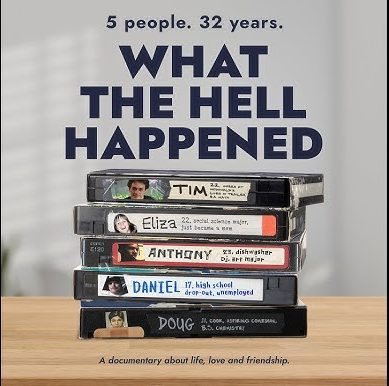
This past Saturday, October 18th, I was planning on attending the screening of Case 137 at the 34th annual Philadelphia Film Festival. Something came up at the last minute and I couldn’t go, so I quickly decided to attend the screening of What the Hell Happened later that night instead. Nothing against Case 137, but boy am I glad it worked out that way. What the Hell Happened is a wonderful tribute to friendship, love, resilience, and the rollercoaster known as life.
What the Hell Happened, directed by couple Matt Wilkins and Eliza Fox, follows a group of five friends: Tim, Doug, Anthony, Daniel, and co-director Eliza. Wilkins also serves as an unofficial sixth character, as his narration and occasional appearances help guide the material. The 98 minute documentary begins in the year 1992 in Iowa City and follows their lives over the course of three decades. In a sense it takes the audience on a journey through time, as we see advances in technology such as better cameras, which results in better video quality. It’s an interesting concept that hasn’t been done many times, at least not on this scale. In the beginning, we’re quickly introduced to these five completely different young adults. Tim, 22, has a B.A. in math but is living in a trailer and working at McDonalds. Doug, 21, has a B.S. in chemistry but ideally wants to be a comedian. Anthony, 23, works as a dishwasher but has bigger goals on his mind. Daniel, 17, who also happens to be Wilkins’ cousin, is the youngest of the group and is an unemployed high school dropout. And of course there’s Eliza, who’s a 22 year old mom that’s unsure about her place in the world.
What really struck me about this documentary is how raw, vulnerable, and relatable it is. A big part of that is how smartly structured it is. The film is separated into five acts, with the first act titled “Angst” and taking place in 1992. It concludes with act five, titled “Bruises”, which basically takes place in the present day and shows where the five friends are currently and how their life choices have affected them today. I was surprised by how moved I was by many of their journeys. In particular I was moved by Doug who, without going into too much detail, faces a serious health issue after years of smoking. We all, in some form or another, can relate to a situation like this, and it makes us care just as much as the filmmakers do. It’s the beauty of the power that film can have.
A reoccurring motif I noticed in the film was that of a river. Throughout the film, the river is constantly changing at the start of each act. I believe it serves as a reminder that no matter how good or bad things are, life goes on and things change, and it’s up to us to keep up or get left behind. While life may be rough right now, there is always hope on the horizon because nothing stays the same forever.
If there’s one criticism I have of this film is that I wish more was explored of their lives between the 90s and present day. More footage of what was going on in their lives in the 2000s and 2010s would’ve painted a more complete picture, but perhaps this was by design. I read somewhere that the first cut was six hours long, and it took multiple attempts to trim it down to 98 minutes. There’s a limit on how much one can include in a documentary, and what we got was one of the most heartfelt and enjoyable viewing experiences I’ve had this year.
Rating: 4/5
 The Reelist